
Further Information
We are in the process of developing resources.
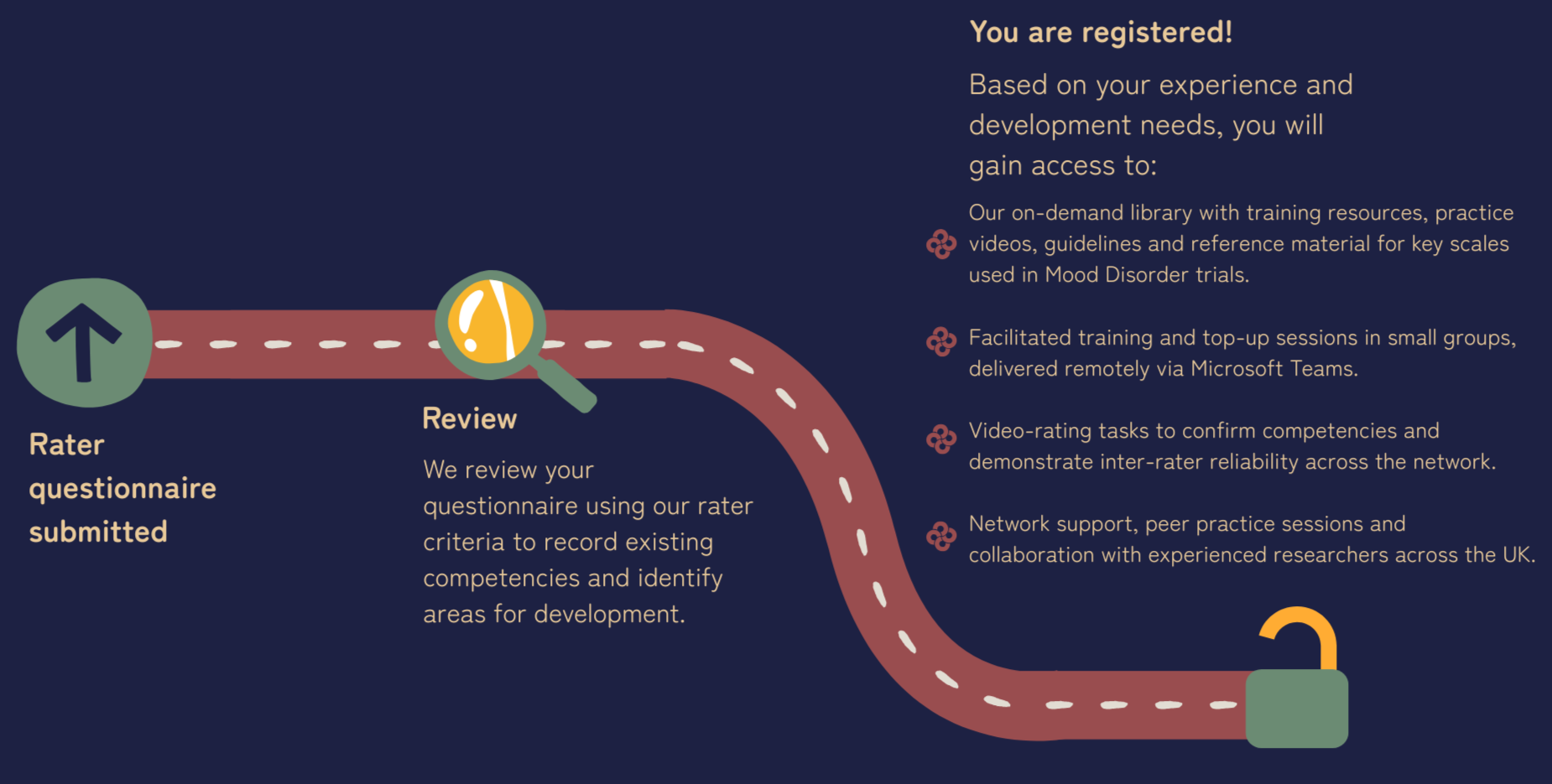
Training and resources are currently being rolled out, with priority given to scales used in the Cohort Study. The library is continuously updated and eligibile raters are contacted to offer training as this becomes available. We are working on facilitated training and peer support provisions - register for updates.
The library can be used by all registered raters from network and affiliate sites.
The on-demand library comprises training (which can also be used for refresher training), reference materials and guidance on license acquisition for rating scales commonly used in mood disorder studies.
We also have overarching best-practice guidelines on using Participant-Reported Outcome Measures and Observer-Rated Outcome Measures (commonly abbreviated as “CROMs” for “Clinician-Rated” but applies to scales administered by non-clinicians as well).
Although PROMs are participant-reported, raters are often involved in instructing completion, clarifying ambiguous terms, reading out items and scoring questionnaires. Variations in these definitions, practices, data collection methods and scoring may make a significant difference to study outcomes. The same applies to CROMs, where differences in observation, interviewing style and interpretation can introduce variability. Therefore, high-quality training and standardised practices are key. These modules provide foundational learning that is lacking in the field, and equips raters with transferable skills for other instruments.
On completion of any training module, raters are required to submit a confirmation to update their site’s capability records and receive a certificate.
Competency is scale-dependent and multi-factorial: the amount of observation, administration practice and scoring practice required depends on the complexity of the scale and the individual rater’s confidence, experience and skills.
Self-directed training does not constitute competency on scales, as we cannot assess each rater’s competency to administer a scale from a network level - this must be determined at site-level.
Before using scales independently, raters should be assessed as competent by Principal Investigators or clinical supervisors, per study guidance. This is because training is the first step in achieving competency and should be complemented by:
Self-directed study of the instrument, manual and validation paper.
Observing multiple instances of administration and co-rating patients presenting with various degrees of symptom severity.
Practicing with colleagues/lived-experience groups with iterative feedback.
Repeating and consolidate these steps.
Interview skills and clinical knowledge and judgement take time to develop, so self-study, observation and practice with parallel supervision are not one-off activities and should be repeated as many times as required.
Some scales will require raters to demonstrate inter-rater reliability (IRR). Raters using these observer-rated scales will be asked to complete rating tasks to confirm IRR with gold-standard scores.
We will advise on the best pathway for each rater:
Raters who require training complete it prior to the IRR assessment.
Raters who have relevant qualifications and/or previous experience or training, and do not require a refresher, skip straight to the IRR assessment.
Raters who do not meet the IRR criteria will receive feedback and be directed to additional support before attempting the IRR task again.
Raters who achieve IRR will recieve certification and their competency will be recorded on the Rater Register to map site and network capabilities.
Rater training should be documented per study and/or site requirements.
We will review responses from the Rater Registration form to identify training needs.
This is determined by:
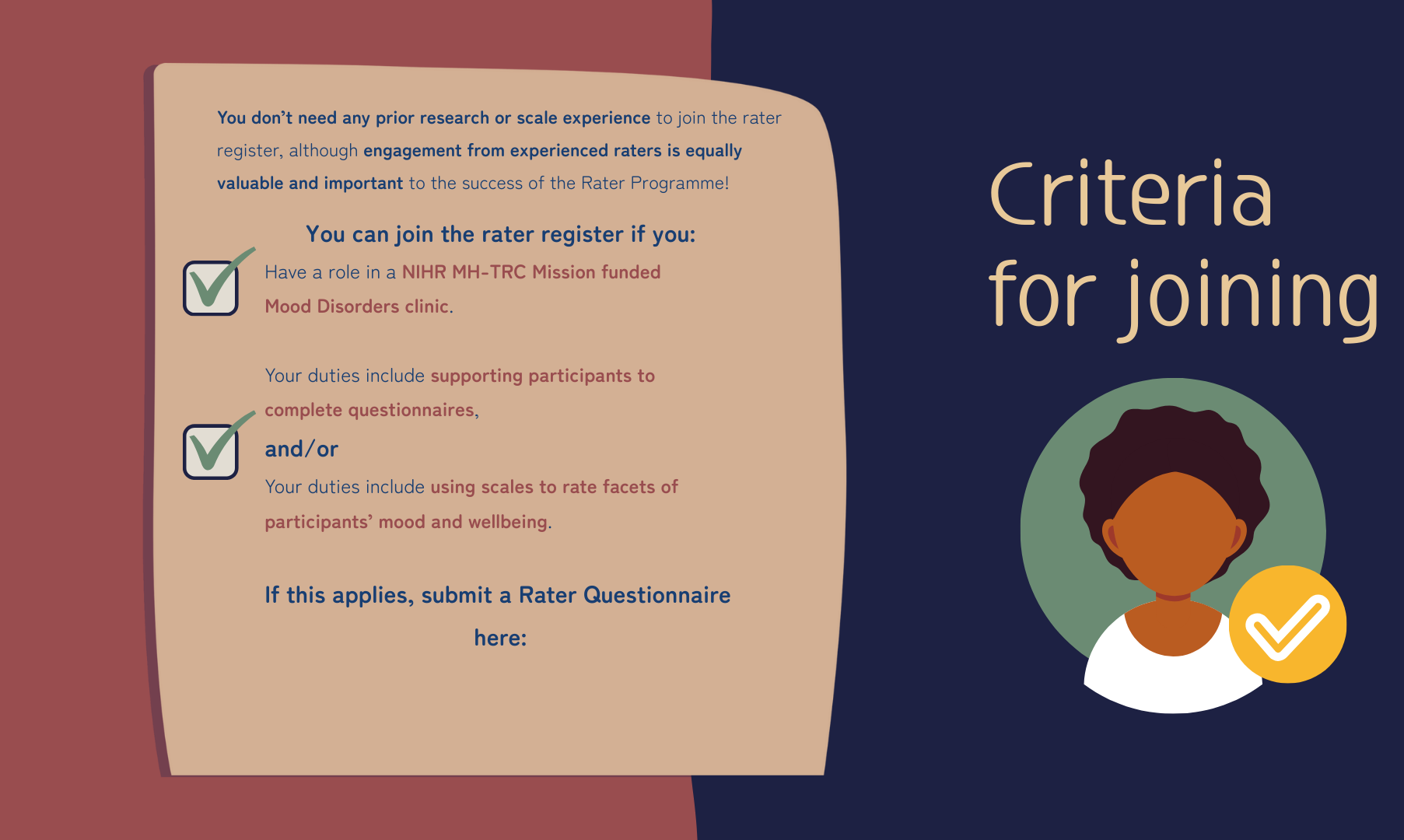
The nature of your rating role in the mood disorders research clinic. This can include helping participants complete questionnaires or “PROMs” by explaining the instructions, clarifying terms or scoring PROMs, and/or administering observer-rated measures or “CROMs” for study-related activities like eligibility assessments and follow-up visits.
Whether you are a clinical rater such as a doctor, nurse or BPS accredited clinical psychologist, or a non-clinical rater such a Clinical Research Practitioner, Clinical Studies Officer or Research Assistant. This is because some scales require clinical judgement for observer ratings, and the appropriate type of clinician for this can also vary.
Previous experience and/or training.
Current Status & Looking Ahead
|
Current Status & Looking Ahead |
The network’s scale resources are under development and the library content is continuously updated.
Our current priority is to support competency on scales used in the Cohort Study. This includes:
PROMs: PHQ-9, PVSS-21, RRS, ASRM, SAPAS, AQ-10, ASRS, ReQoL-10, AUDIT and DUDIT.
CROMs: ATHF, CGI-S and MADRS, plus guidelines for clinicians making diagnostic decisions for the trial.
In due course, we will aim to support training on:
PROMs: EQ-5D-5L, SDS, GAD-7, QIDS-SR, WSAS, PANAS, 5D-ASC, MGH-ATRQ, DSST, STAR-P and STAR-C.
CROMs: HAM-D, CSSRS and PANSS.
If your site urgently requires training that is not yet available but needed for a network study, please contact us.
Otherwise, keep an eye on your inbox or this website for updates.